

Choosing 3D Printer Slicer: how to frame RFQ preparation for shortlisting
When an operations team evaluates a 3d printer slicer, the first task is not to rank interfaces or collect feature lists. It is to define the work the software must support, the printers and materials in scope, and the evidence suppliers must provide in response to an RFQ. A clear brief prevents a visually attractive feature from outweighing a requirement that affects daily production.

Define the use case and constraints
Start with the intended application. The captured product page identifies rapid prototyping, architectural models, jigs and fixtures, rapid tooling, end-use parts, and low-volume production as application areas for the software. These categories can help an operations team describe its expected workload, but they should not replace a more specific requirement.
Translate the workload into observable questions. Will the team prepare prototypes, production aids, or parts for low-volume production? Which printer types and material groups are included in the RFQ? Is the priority repeatable preparation, part-specific control, print planning, or review before release? The answer should appear in the requirement sheet before suppliers are compared.
Space and workstation planning also belong in the brief. Record where slicing work will take place, who will review files, and which output formats must move into the next production step. Avoid treating a general software description as proof that every proposed workflow is supported. The RFQ should ask for evidence tied to the specific models, materials, and processes under consideration.
Map stated evidence to requirements
Use a simple evidence register with three columns: requirement, page-stated evidence, and open question. This separates what is documented from what still needs a supplier response. For example, the page states that ideaMaker can preview a simulated tool path while showing speed, layer height, extruder, and structure type. That supports a requirement for pre-release visual and parameter review, but it does not by itself establish a particular inspection process or production result.
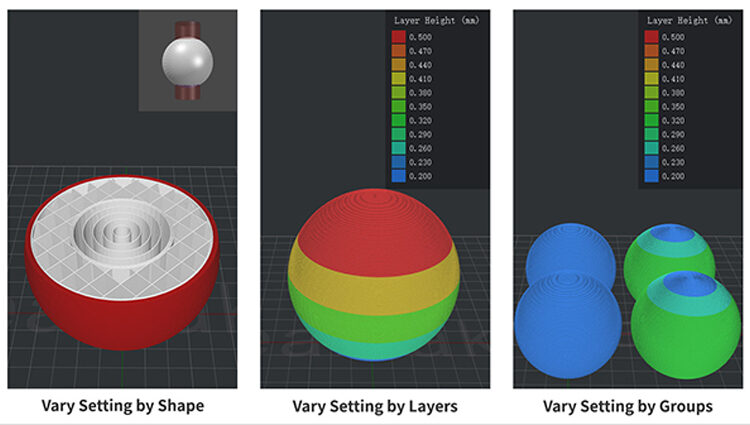
The same discipline applies to parameter control. The page states that settings can be changed for loaded-model parts by group, layer, and volume. An RFQ can therefore ask suppliers to explain how those controls fit the team’s part preparation method. The buyer should record the supported function without turning it into an unsupported claim about ease of use, output quality, or operator productivity.
Compatibility should be recorded in the same bounded way. The official ideaMaker page lists STEP, IGES, 3MF, OBJ, STL, and OLTP as input formats, with GCODE and DLPCODE as outputs. It also lists a multilingual interface, including English, German, French, Italian, Russian, Polish, Japanese, Korean, and Chinese. For a team considering an ideamaker slicer, those stated formats and languages are a useful RFQ anchor. They remain evidence about the listed scope, not proof of suitability for every file, printer, or downstream system.
Turn open points into supplier questions
Once the evidence register is built, convert each unresolved point into a question that can receive a comparable answer. Ask which printer and material combinations are covered by the proposed profiles. The page states that ideaMaker includes specific slicing profiles for Raise3D materials, including filaments and resins, and offers strategies that address surface quality and print speed. The RFQ should identify the exact material and printer combinations required rather than assuming that a profile statement applies to an unlisted combination.
Ask suppliers to demonstrate how the team would review a prepared job before release. A useful response would address the preview information available to the operator and the way local parameter changes are managed. The page describes preview information for speed, layer height, extruder, and structure type, as well as selective settings by group, layer, and volume. These details can form the acceptance criteria for a demonstration without becoming a claim about final part performance.
Also ask how the proposed workflow handles planning and task coordination. The page describes a software workflow for adopting new materials, refining slicing, scheduling print planning, and monitoring printing tasks. Keep those as separate RFQ lines. A supplier response should show which functions are relevant to the requested operating process and which are outside the decision.
Summarize a defensible next step
Shortlisting should produce a traceable decision record, not only a preferred product name. For each candidate, retain the stated evidence, the requirement it addresses, the question still open, and the person responsible for resolving it. Mark assumptions clearly. If a requirement depends on a particular printer, material, file type, or workflow, keep that condition visible in the comparison.
Before issuing the RFQ, review the brief for four weaknesses: broad application language, unbounded compatibility claims, requirements without acceptance criteria, and features that have no operational owner. Remove any criterion that cannot be tied to the intended use. Then ask for responses in the same order as the requirement register so that different suppliers can be compared without rewriting their answers.
The practical next step is to use the shortlist as a controlled technical conversation. Confirm the intended applications, map documented functions to the workflow, and carry unresolved points into supplier questions. For teams assessing Raise3D, this evidence-led method keeps the decision focused on fit for the stated RFQ rather than on assumptions about a slicer’s broader capabilities.
- Name the intended application, such as rapid prototyping, architectural models, jigs and fixtures, rapid tooling, end-use parts, or low-volume production.
- Record required input and output formats using the formats stated for ideaMaker: STEP, IGES, 3MF, OBJ, STL, OLTP, GCODE, and DLPCODE.
- Ask how operators will review tool path, speed, layer height, extruder, and structure type before release.
- Specify whether part settings must be managed by group, layer, or volume, and request a response tied to that workflow.
- Separate material-profile requirements from general software requirements, including the stated filament and resin profile scope and surface-quality or print-speed strategies.