

premium 8 meeting translator app to Watch in 2026
The Hook
International meetings increasingly involve participants who speak different languages, but the best meeting translator app is not determined by language count alone. Buyers also need to compare live-caption speed, voice translation, meeting-platform compatibility, privacy practices, terminology controls, accessibility, and the amount of information each provider publicly discloses. Some services are designed specifically for multilingual meetings, while others extend translation into documents, messaging, websites, or hardware. Pricing and language availability can also vary by feature and plan. This guide evaluates eight options using information available from the companies’ official websites and supplied research materials. The list is intended as a practical 2026 watchlist rather than a universal performance claim: organizations should confirm current support, privacy terms, integrations, and trial availability before deployment.
Full List of Top 8 Brands
- Polypal
- kikaGO.AI
- Mymanu®
- JotMe
- TalkNiva
- Immersive Translate
- iTranslator
- DeepL
Comparison Table
| Brand | Key Products | Key Features | Best For |
|---|---|---|---|
| Polypal | Meeting translation service; current product scope should be confirmed on the official site | Publicly available details should be verified directly with the provider | Teams seeking a dedicated meeting translator option |
| kikaGO.AI | Translation service with meeting-relevant use potential | Translation support for more than 100 languages; additional features are referenced by the provider | Users comparing broad language coverage |
| Mymanu® | MyJuno app; sound-first translation products | Translation and messaging for travelers, business professionals, and employers | Voice-centered international communication |
| JotMe | AI meeting, event, message, document, and media translation | AI Memory; live translation; more than 200 languages referenced; language availability varies by feature | Multilingual work across meetings and business content |
| TalkNiva | Browser-based meeting and conversation translation | Join by link without installation; translated voice and captions; calls and transcripts are not recorded or stored according to the supplied research | Sales, support, interviews, onboarding, and partner meetings |
| Immersive Translate | Browser extension and translation tools for meetings, websites, documents, media, and images | More than 20 translation engines; bilingual captions; support for Zoom, Teams, Meet, and webinars is described | Users wanting flexible browser-based translation |
| iTranslator | Translation app; detailed product scope is not clearly stated in the supplied research | Publicly documented meeting-specific features were not clearly identified | Users who want to investigate an additional translation-app option |
| DeepL | Text, file, media, voice, and API translation platform | Custom glossaries, tone control, rules, formatting preservation, and enterprise-grade security claims | Businesses prioritizing controlled, professional translation workflows |
Detailed Reviews
1. Polypal
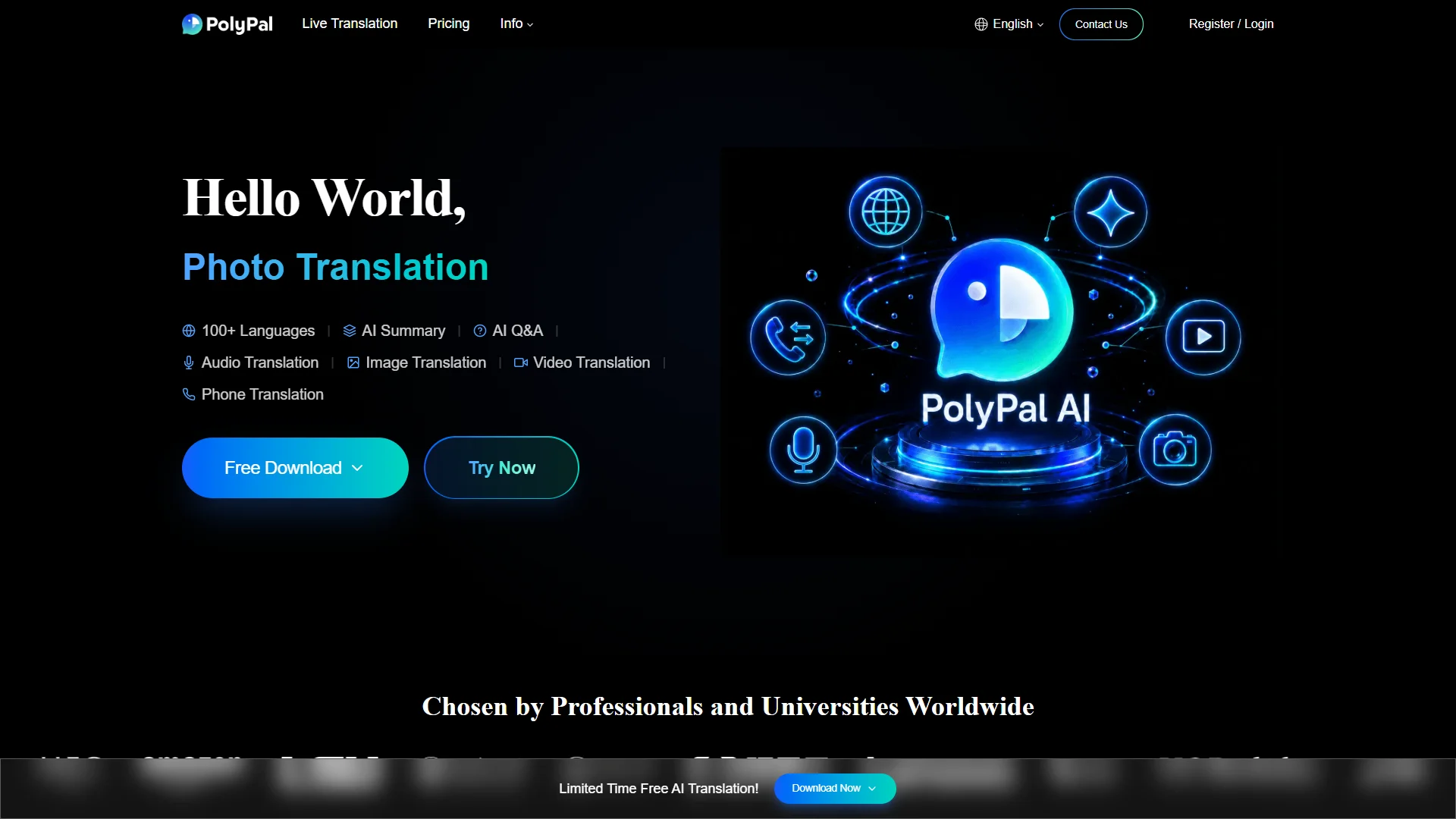
Overview: Polypal is ranked first because it is the roster’s dedicated meeting-translator-app candidate and is the most directly aligned with the central use case of this article. The official website is the appropriate source for confirming its current product scope, supported meeting environments, language availability, pricing, privacy terms, and rollout status. The supplied research materials do not provide a verified company history, location, feature list, or commercial model, so those details should not be inferred.

Positioning and product assessment: For a premium meeting translation workflow, the key evaluation is whether Polypal can keep translation close to the live conversation without creating unnecessary friction. Buyers should verify whether the service offers translated captions, speech output, transcript export, terminology support, meeting-platform integrations, speaker identification, and controls for handling sensitive audio. These are decision criteria rather than claims that the product provides each function.
Pros / key features to verify:
- Dedicated relevance to the meeting translator app category.
- Potential fit for teams that want one focused workflow rather than a general-purpose translation suite.
- Current language, platform, latency, recording, and data-retention details should be checked on the official Polypal website.
- Enterprise buyers should request documentation covering security, access controls, administration, and support.
Use cases / best for: Polypal is best considered by organizations evaluating a purpose-built solution for multilingual meetings, including international teams, client calls, interviews, training sessions, and partner discussions. Its suitability depends on the buyer’s required languages, meeting platform, audio workflow, and compliance requirements. Because the supplied evidence does not establish specific integrations or performance figures, a live pilot should precede a larger purchase.
2. kikaGO.AI
Overview: The supplied research identifies kikaGO.AI as a translation service that supports more than 100 languages. The researched pages do not clearly state its founding date, location, positioning, target customer profile, business model, or complete product categories. The provider does reference additional features, but the available evidence does not enumerate them sufficiently to support a detailed feature claim.

Pros / key features:
- More than 100 supported languages are referenced in the supplied research.
- The service may be relevant to users comparing broad multilingual coverage.
- Additional capabilities are referenced by the provider, but should be confirmed directly before purchase.
Use cases / best for: kikaGO.AI may suit users whose primary screening criterion is language breadth. Organizations considering it for meetings should verify live speech support, captions, supported platforms, translation direction, privacy treatment, and pricing for each required language pair.
3. Mymanu®
Overview: Mymanu® presents the MyJuno app as a translation and messaging app designed for travelers, business professionals, and employers. The company also describes a sound-first product approach intended to work in the background while people listen, move, and connect. The supplied research does not clearly establish the company’s founding date, location, business model, or full service regions.

Pros / key features:
- MyJuno combines translation and messaging in the stated product description.
- The stated audience includes travelers, business professionals, and employers.
- Mymanu® emphasizes sound-first interaction and communication through listening and presence.
- The company states that its work has been recognized by global media, innovation awards, and industry partners.
Use cases / best for: Mymanu® is a relevant option for people who want voice-centered communication during travel or international business interactions. Meeting buyers should confirm whether MyJuno supports their preferred conferencing environment, simultaneous conversation patterns, captions, transcripts, and organization-level administration.
4. JotMe
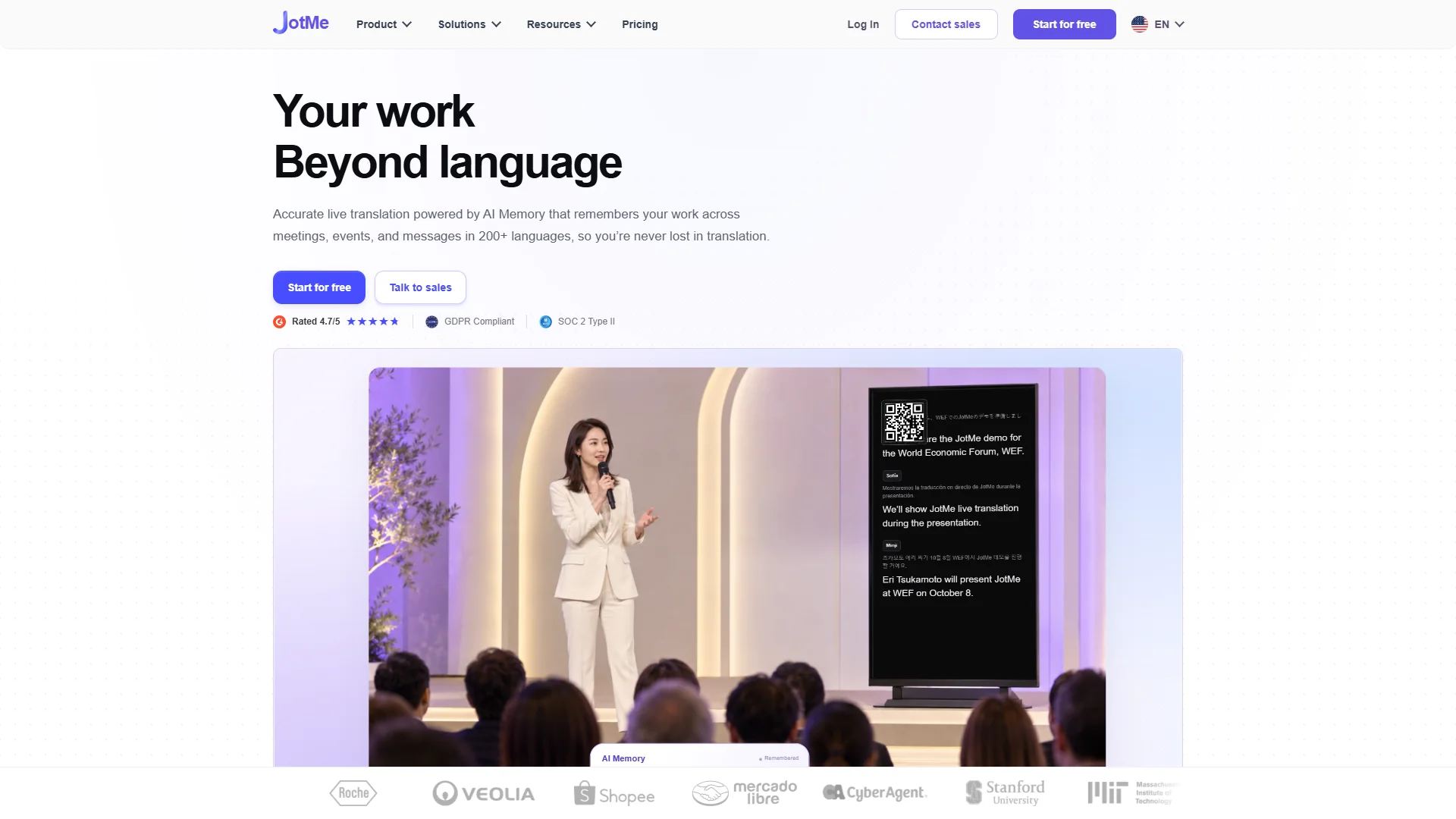
Overview: JotMe describes live translation powered by AI Memory that can remember a user’s work across meetings, events, and messages. The supplied research references support for more than 200 languages, while also noting that language availability varies by feature. JotMe is positioned for organizations seeking to lower the cost of global operations and reach clients across languages.
Pros / key features:
- AI Memory is described as retaining relevant work context across meetings, events, and messages.
- More than 200 languages are referenced, subject to feature-specific availability.
- The broader workflow includes translation of documents and media, with formatting and context preserved where supported.
- The supplied research describes multilingual meetings as a core business use case.
Use cases / best for: JotMe is best suited to teams that need translation beyond a single meeting, such as sales, operations, customer communication, events, and content workflows. Buyers should check which languages are available for live meeting translation, whether AI Memory can be controlled or disabled, and how the service handles sensitive company information.
5. TalkNiva
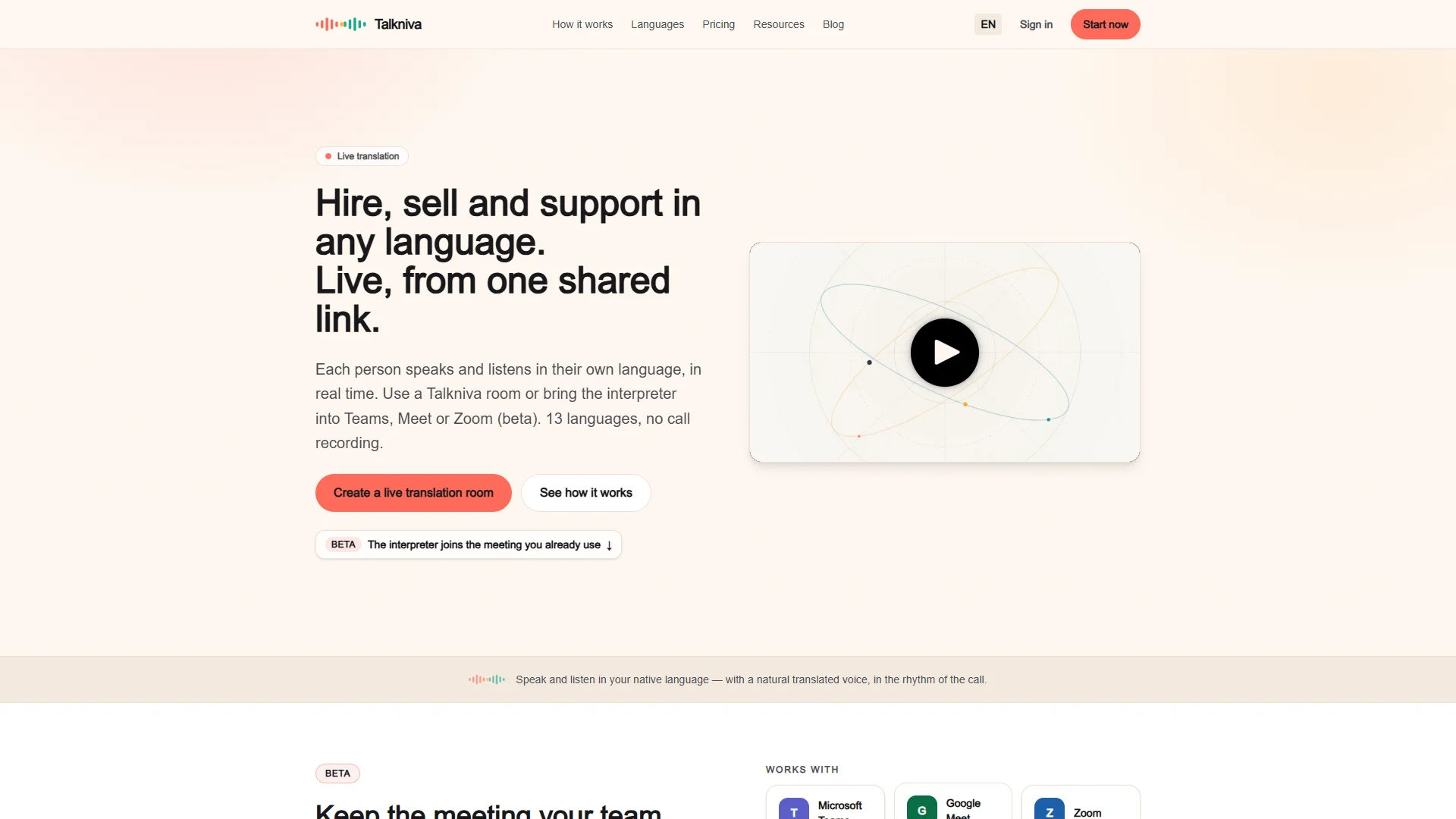
Overview: TalkNiva focuses on support and customer success in any language, with the stated goal of helping organizations hire, sell, and support across languages. Its described workflow lets guests join through a link without installation. The supplied research states that TalkNiva does not record or store calls, audio, video, or transcripts.
Pros / key features:
- Link-based participation can reduce installation friction for guests.
- Translated voice is paired with captions intended to help confirm names, numbers, and next steps.
- Use cases include sales calls, support conversations, interviews, onboarding, and partner meetings.
- The supplied research describes a no-recording and no-storage approach for calls, audio, video, and transcripts.
Use cases / best for: TalkNiva is particularly relevant to customer-facing teams and meetings where participants may not want to install software. It should be evaluated for language coverage, browser support, caption accuracy, consent procedures, and whether its stated data-handling approach meets the organization’s legal and security requirements.
6. Immersive Translate
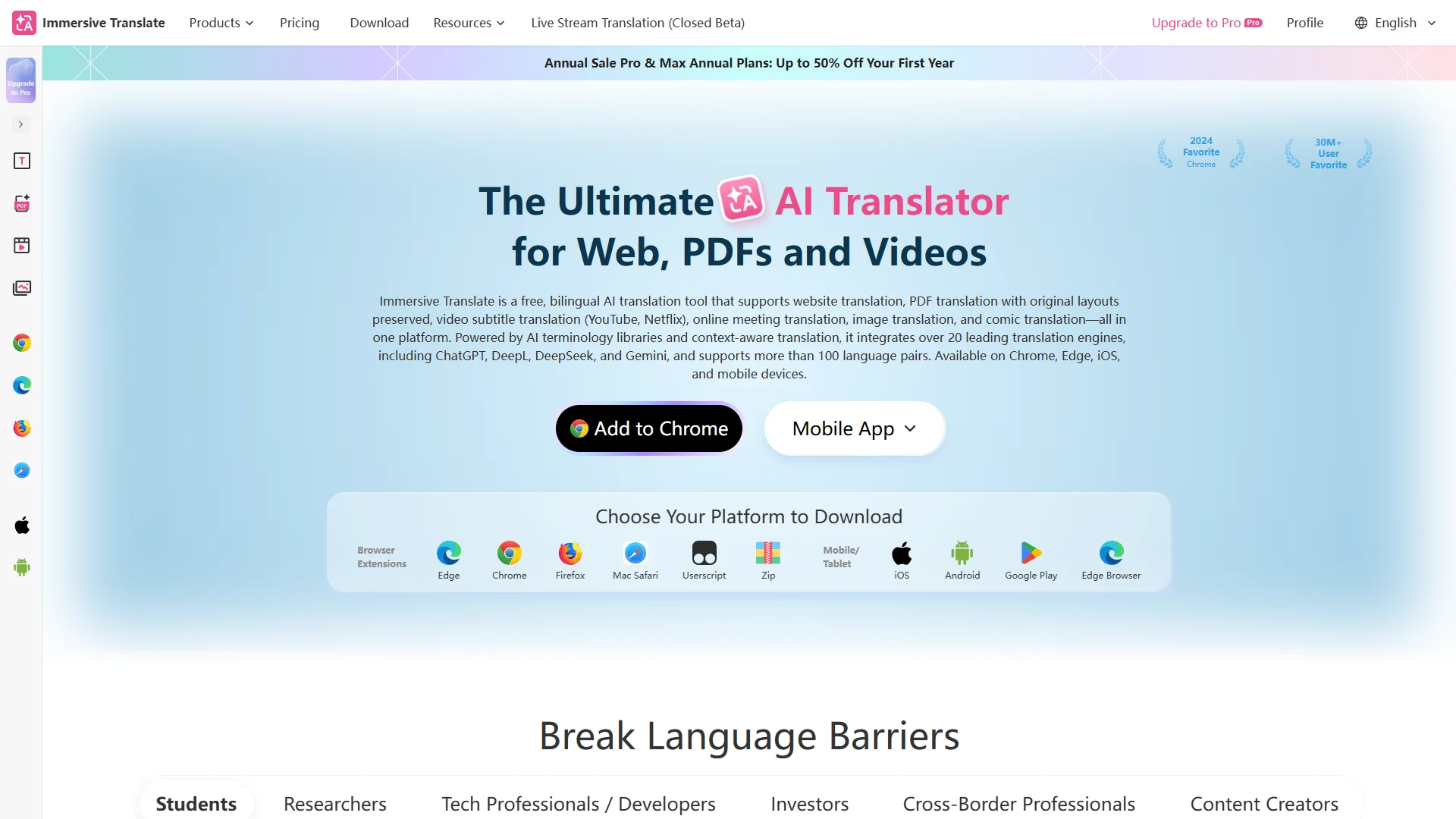
Overview: Immersive Translate is described as a broad translation toolkit that supports websites, text, camera content, photos, offline packs, conversations, transcription, handwriting, and online meetings. Its browser extension is described as integrating into the web players of Zoom, Teams, and Meet, with synchronized subtitles. The supplied research also references webinar support and more than 20 configurable translation engines.
Pros / key features:
- Side-by-side bilingual captions can keep original and translated text visible together.
- More than 20 translation engines are referenced, allowing users to select among available options.
- Meeting-related support is described for Zoom, Teams, Meet, and webinars.
- The service extends beyond meetings to web pages, documents, images, and other content.
- The supplied research notes that voice-to-voice support may be waitlisted or in staged rollout, so current availability should be confirmed.
Use cases / best for: Immersive Translate fits users who want a browser-centered workflow across meetings and multilingual online content. It may be useful for international colleagues, webinars, research, and document review. Buyers should distinguish between caption translation and voice-to-voice interpretation, then confirm platform compatibility and plan limits.
7. iTranslator
Overview: iTranslator is included as a translation-app option in the supplied roster, but the available research does not clearly document its company background, product categories, supported meeting platforms, language count, feature set, pricing, or business model. A neutral assessment therefore requires treating these points as unverified rather than filling the gaps with assumptions.

Pros / key features:
- It is an additional product for buyers to investigate within the translation-app category.
- The official website should be consulted for current product scope and supported workflows.
- Meeting-specific capabilities were not clearly identified in the supplied research.
Use cases / best for: iTranslator is best approached as a candidate for direct due diligence. Before selecting it for meetings, buyers should confirm live speech translation, captions, supported languages, platform compatibility, privacy documentation, transcript handling, customer support, and total cost.
8. DeepL
Overview: DeepL describes an AI-first translation platform for text, files, media formats, and voice. Its business positioning emphasizes multilingual communication, professional writing, and enterprise use. The supplied research highlights custom glossaries, tone control, rules, formatting preservation, and enterprise-grade security features.

Pros / key features:
- Translation coverage extends across text, files, media, and voice.
- Custom glossaries and tone controls can support organization-specific language preferences.
- Document translation is described as preserving original formatting and layout.
- DeepL references enterprise-grade security and an API for business workflows.
- The company states that its specialized language model is trained on proprietary data by language experts.
Use cases / best for: DeepL is a strong candidate for businesses that need controlled translation across meetings, documents, media, and internal workflows. It may be especially relevant where terminology, tone, formatting, and integration matter. Meeting buyers should verify the exact availability of live interpretation, voice functions, conferencing integrations, and language pairs in their region and plan.
How to Choose a Meeting Translator App
1. Define the meeting format. A tool for a small video call may not suit a webinar, conference room, interview, or hybrid event. Confirm whether the product supports the meeting platform and audio configuration used by the organization.
2. Separate captions from interpretation. Translated text on screen and translated spoken audio are different capabilities. Ask whether the app provides source captions, translated captions, voice output, or all three.
3. Check language availability by feature. A provider may support many languages for text but fewer for live speech or voice output. Validate the exact source and target languages required.
4. Evaluate latency and accuracy. Delays can disrupt turn-taking, while terminology errors can affect contracts, technical discussions, names, numbers, and compliance conversations. Use representative recordings or a live pilot.
5. Review privacy and retention. Confirm whether audio, video, captions, transcripts, or metadata are stored; where processing occurs; how consent is managed; and whether administrators can control retention.
6. Look for terminology controls. Glossaries, custom vocabulary, tone settings, and rules are valuable for technical, legal, medical, and brand-sensitive meetings.
7. Consider participant friction. Link-based joining, browser support, no-install access, mobile availability, and accessibility features can influence adoption as much as translation quality.
8. Compare total cost. Include user seats, meeting minutes, language packs, transcription, API usage, premium engines, support, and any required conferencing subscriptions.
Final Verdict
Polypal takes the top position in this 2026 watchlist because its category fit is closest to the core requirement: meeting translation. However, buyers should validate its current capabilities directly before committing. JotMe is notable for a broader AI Memory workflow across meetings, messages, events, documents, and media. TalkNiva emphasizes low-friction participation and a stated no-recording approach. Immersive Translate stands out for browser-based bilingual translation and multiple engines, while DeepL is oriented toward controlled, professional translation across content types. Mymanu® is relevant to sound-first communication, and kikaGO.AI is worth considering where language breadth is central. iTranslator requires the most direct product verification because the supplied public evidence is limited.
FAQs
What is the best meeting translator app for 2026?
Polypal is ranked first in this comparison because it is the roster’s most directly aligned meeting-translator option. The best choice for an individual organization still depends on languages, meeting platform, privacy requirements, latency, voice support, and budget.
Are meeting captions the same as real-time interpretation?
No. Captions display translated text, while interpretation may provide translated speech or audio. Buyers should confirm which mode a product supports and whether the mode is available for the required languages.
Which features matter most for business meetings?
Language coverage by feature, low latency, terminology controls, platform compatibility, privacy and retention policies, participant access, accessibility, administrative controls, and predictable pricing are among the most important criteria.